 Add to Chrome
 Add to Firefox
 Add to Edge
VLMs are Good Teachers for Video Reasoning via Adaptive Test-Time Optimization
Jun 01, 2026
The recent "Reasoning with Video" paradigm utilizes Video Generation Models (VGMs) to generate temporally coherent visual trajectories to complete reasoning tasks. Although state-of-the-art VGMs excel at visual quality, they often struggle to understand and follow task-specific rules, leading to logical failures across diverse reasoning scenarios. Existing efforts try to utilize Vision-Language Models (VLMs) as problem pre-solvers to produce or refine textual guidance for the VGM. However, textual descriptions fail to capture intricate spatiotemporal details, and VGMs often struggle to faithfully execute fine-grained or long-tail instructions even with a valid plan. While VLMs struggle as solvers, they possess strong perception capabilities to evaluate process-constraint satisfaction and final-goal achievement. Leveraging this strength, we introduce a paradigm shift that transitions the role of VLMs to "teachers". Specifically, a VLM teacher extracts task-specific rules to formulate differentiable rewards, guiding a VGM Reasoner via test-time online optimization of a lightweight LoRA module. This strategy enables adaptive test-time optimization and extends the reasoning capabilities beyond the VGM's intrinsic boundaries. Evaluations on symbolic (VBVR-Bench) and general-purpose (RULER-Bench) video reasoning benchmarks show that the proposed method yields a 16.7-point average performance gain, outperforming the VLM-as-Solver paradigm (+0.4 points) and Best-of-N scaling (+2.2 points) by a large margin at comparable test-time cost. These findings reveal that integrating VLMs as test-time teachers offers a promising paradigm for achieving generalizable video reasoning. Project Page: https://VLM-as-Teacher.github.io/

SRC-Flow: Compact Semantic Representations Enable Normalizing Flows for Image Generation
May 18, 2026Normalizing flows (NFs) provide exact likelihoods and deterministic invertible sampling, but have historically lagged behind diffusion models for large-scale image generation. We identify a key obstacle: NFs are required to learn a single invertible transport over the full ambient space, making them highly sensitive to high-dimensional representations. This leads to a semantic-capacity mismatch in modern visual representation spaces, where semantic information is compact but encoded in overcomplete features. We propose SRC-Flow, which introduces a Semantic Representation Compressor (SRC) to compact high-dimensional RAE features into a low-dimensional semantic space before flow modeling and preserve reconstruction through the frozen RAE decoder. This compact space reduces the modeling burden of NFs and enables effective likelihood-based generation in semantic representation space. We further adopt constant noise regularization tailored to the fixed unconditional bijection learned by flows. On ImageNet $256 \times 256$ and $512 \times 512$, SRC-Flow achieves state-of-the-art generation quality among normalizing flow methods, with gFID scores of 1.65 and 2.07 under classifier-free guidance, while retaining exact likelihood computation in the compact semantic representation space and deterministic invertible sampling at the flow level. Codes and models will be available at https://github.com/longtaojiang/SRC-Flow.
Amodal SAM: A Unified Amodal Segmentation Framework with Generalization
Apr 22, 2026Amodal segmentation is a challenging task that aims to predict the complete geometric shape of objects, including their occluded regions. Although existing methods primarily focus on amodal segmentation within the training domain, these approaches often lack the generalization capacity to extend effectively to novel object categories and unseen contexts. This paper introduces Amodal SAM, a unified framework that leverages SAM (Segment Anything Model) for both amodal image and amodal video segmentation. Amodal SAM preserves the powerful generalization ability of SAM while extending its inherent capabilities to the amodal segmentation task. The improvements lie in three aspects: (1) a lightweight Spatial Completion Adapter that enables occluded region reconstruction, (2) a Target-Aware Occlusion Synthesis (TAOS) pipeline that addresses the scarcity of amodal annotations by generating diverse synthetic training data, and (3) novel learning objectives that enforce regional consistency and topological regularization. Extensive experiments demonstrate that Amodal SAM achieves state-of-the-art performance on standard benchmarks, while simultaneously exhibiting robust generalization to novel scenarios. We anticipate that this research will advance the field toward practical amodal segmentation systems capable of operating effectively in unconstrained real-world environments.
Stable Velocity: A Variance Perspective on Flow Matching
Feb 05, 2026While flow matching is elegant, its reliance on single-sample conditional velocities leads to high-variance training targets that destabilize optimization and slow convergence. By explicitly characterizing this variance, we identify 1) a high-variance regime near the prior, where optimization is challenging, and 2) a low-variance regime near the data distribution, where conditional and marginal velocities nearly coincide. Leveraging this insight, we propose Stable Velocity, a unified framework that improves both training and sampling. For training, we introduce Stable Velocity Matching (StableVM), an unbiased variance-reduction objective, along with Variance-Aware Representation Alignment (VA-REPA), which adaptively strengthen auxiliary supervision in the low-variance regime. For inference, we show that dynamics in the low-variance regime admit closed-form simplifications, enabling Stable Velocity Sampling (StableVS), a finetuning-free acceleration. Extensive experiments on ImageNet $256\times256$ and large pretrained text-to-image and text-to-video models, including SD3.5, Flux, Qwen-Image, and Wan2.2, demonstrate consistent improvements in training efficiency and more than $2\times$ faster sampling within the low-variance regime without degrading sample quality. Our code is available at https://github.com/linYDTHU/StableVelocity.
VMonarch: Efficient Video Diffusion Transformers with Structured Attention
Jan 29, 2026The quadratic complexity of the attention mechanism severely limits the context scalability of Video Diffusion Transformers (DiTs). We find that the highly sparse spatio-temporal attention patterns exhibited in Video DiTs can be naturally represented by the Monarch matrix. It is a class of structured matrices with flexible sparsity, enabling sub-quadratic attention via an alternating minimization algorithm. Accordingly, we propose VMonarch, a novel attention mechanism for Video DiTs that enables efficient computation over the dynamic sparse patterns with structured Monarch matrices. First, we adapt spatio-temporal Monarch factorization to explicitly capture the intra-frame and inter-frame correlations of the video data. Second, we introduce a recomputation strategy to mitigate artifacts arising from instabilities during alternating minimization of Monarch matrices. Third, we propose a novel online entropy algorithm fused into FlashAttention, enabling fast Monarch matrix updates for long sequences. Extensive experiments demonstrate that VMonarch achieves comparable or superior generation quality to full attention on VBench after minimal tuning. It overcomes the attention bottleneck in Video DiTs, reduces attention FLOPs by a factor of 17.5, and achieves a speedup of over 5x in attention computation for long videos, surpassing state-of-the-art sparse attention methods at 90% sparsity.
SALAD: Achieve High-Sparsity Attention via Efficient Linear Attention Tuning for Video Diffusion Transformer
Jan 23, 2026Diffusion Transformers have recently demonstrated remarkable performance in video generation. However, the long input sequences result in high computational latency due to the quadratic complexity of full attention. Various sparse attention mechanisms have been proposed. Training-free sparse attention is constrained by limited sparsity and thus offers modest acceleration, whereas training-based methods can reach much higher sparsity but demand substantial data and computation for training. In this work, we propose SALAD, introducing a lightweight linear attention branch in parallel with the sparse attention. By incorporating an input-dependent gating mechanism to finely balance the two branches, our method attains 90% sparsity and 1.72x inference speedup, while maintaining generation quality comparable to the full attention baseline. Moreover, our finetuning process is highly efficient, requiring only 2,000 video samples and 1,600 training steps with a batch size of 8.
CamPilot: Improving Camera Control in Video Diffusion Model with Efficient Camera Reward Feedback
Jan 22, 2026Recent advances in camera-controlled video diffusion models have significantly improved video-camera alignment. However, the camera controllability still remains limited. In this work, we build upon Reward Feedback Learning and aim to further improve camera controllability. However, directly borrowing existing ReFL approaches faces several challenges. First, current reward models lack the capacity to assess video-camera alignment. Second, decoding latent into RGB videos for reward computation introduces substantial computational overhead. Third, 3D geometric information is typically neglected during video decoding. To address these limitations, we introduce an efficient camera-aware 3D decoder that decodes video latent into 3D representations for reward quantization. Specifically, video latent along with the camera pose are decoded into 3D Gaussians. In this process, the camera pose not only acts as input, but also serves as a projection parameter. Misalignment between the video latent and camera pose will cause geometric distortions in the 3D structure, resulting in blurry renderings. Based on this property, we explicitly optimize pixel-level consistency between the rendered novel views and ground-truth ones as reward. To accommodate the stochastic nature, we further introduce a visibility term that selectively supervises only deterministic regions derived via geometric warping. Extensive experiments conducted on RealEstate10K and WorldScore benchmarks demonstrate the effectiveness of our proposed method. Project page: \href{https://a-bigbao.github.io/CamPilot/}{CamPilot Page}.
A Mechanistic View on Video Generation as World Models: State and Dynamics
Jan 22, 2026Large-scale video generation models have demonstrated emergent physical coherence, positioning them as potential world models. However, a gap remains between contemporary "stateless" video architectures and classic state-centric world model theories. This work bridges this gap by proposing a novel taxonomy centered on two pillars: State Construction and Dynamics Modeling. We categorize state construction into implicit paradigms (context management) and explicit paradigms (latent compression), while dynamics modeling is analyzed through knowledge integration and architectural reformulation. Furthermore, we advocate for a transition in evaluation from visual fidelity to functional benchmarks, testing physical persistence and causal reasoning. We conclude by identifying two critical frontiers: enhancing persistence via data-driven memory and compressed fidelity, and advancing causality through latent factor decoupling and reasoning-prior integration. By addressing these challenges, the field can evolve from generating visually plausible videos to building robust, general-purpose world simulators.
Alchemist: Unlocking Efficiency in Text-to-Image Model Training via Meta-Gradient Data Selection
Dec 18, 2025Recent advances in Text-to-Image (T2I) generative models, such as Imagen, Stable Diffusion, and FLUX, have led to remarkable improvements in visual quality. However, their performance is fundamentally limited by the quality of training data. Web-crawled and synthetic image datasets often contain low-quality or redundant samples, which lead to degraded visual fidelity, unstable training, and inefficient computation. Hence, effective data selection is crucial for improving data efficiency. Existing approaches rely on costly manual curation or heuristic scoring based on single-dimensional features in Text-to-Image data filtering. Although meta-learning based method has been explored in LLM, there is no adaptation for image modalities. To this end, we propose **Alchemist**, a meta-gradient-based framework to select a suitable subset from large-scale text-image data pairs. Our approach automatically learns to assess the influence of each sample by iteratively optimizing the model from a data-centric perspective. Alchemist consists of two key stages: data rating and data pruning. We train a lightweight rater to estimate each sample's influence based on gradient information, enhanced with multi-granularity perception. We then use the Shift-Gsampling strategy to select informative subsets for efficient model training. Alchemist is the first automatic, scalable, meta-gradient-based data selection framework for Text-to-Image model training. Experiments on both synthetic and web-crawled datasets demonstrate that Alchemist consistently improves visual quality and downstream performance. Training on an Alchemist-selected 50% of the data can outperform training on the full dataset.
StereoPilot: Learning Unified and Efficient Stereo Conversion via Generative Priors
Dec 18, 2025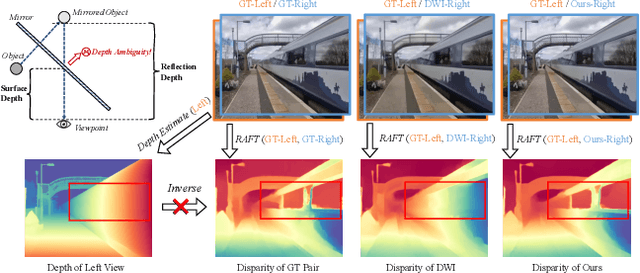

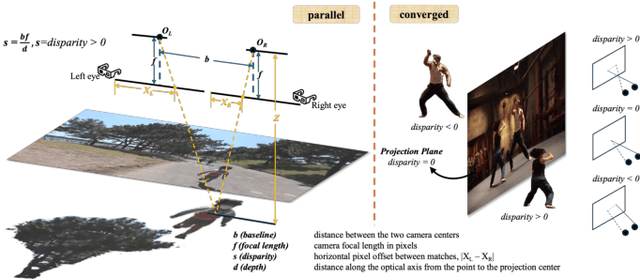
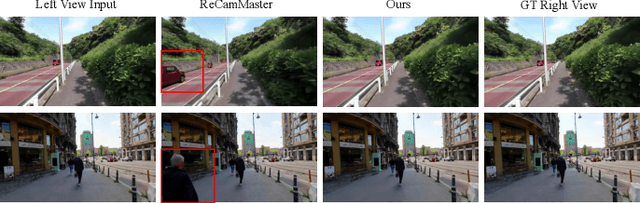
The rapid growth of stereoscopic displays, including VR headsets and 3D cinemas, has led to increasing demand for high-quality stereo video content. However, producing 3D videos remains costly and complex, while automatic Monocular-to-Stereo conversion is hindered by the limitations of the multi-stage ``Depth-Warp-Inpaint'' (DWI) pipeline. This paradigm suffers from error propagation, depth ambiguity, and format inconsistency between parallel and converged stereo configurations. To address these challenges, we introduce UniStereo, the first large-scale unified dataset for stereo video conversion, covering both stereo formats to enable fair benchmarking and robust model training. Building upon this dataset, we propose StereoPilot, an efficient feed-forward model that directly synthesizes the target view without relying on explicit depth maps or iterative diffusion sampling. Equipped with a learnable domain switcher and a cycle consistency loss, StereoPilot adapts seamlessly to different stereo formats and achieves improved consistency. Extensive experiments demonstrate that StereoPilot significantly outperforms state-of-the-art methods in both visual fidelity and computational efficiency. Project page: https://hit-perfect.github.io/StereoPilot/.